

What the Latest AHA Guidelines Mean for Maryland
CPR Training Continues to Evolve
CPR training is not something that should remain frozen in time.
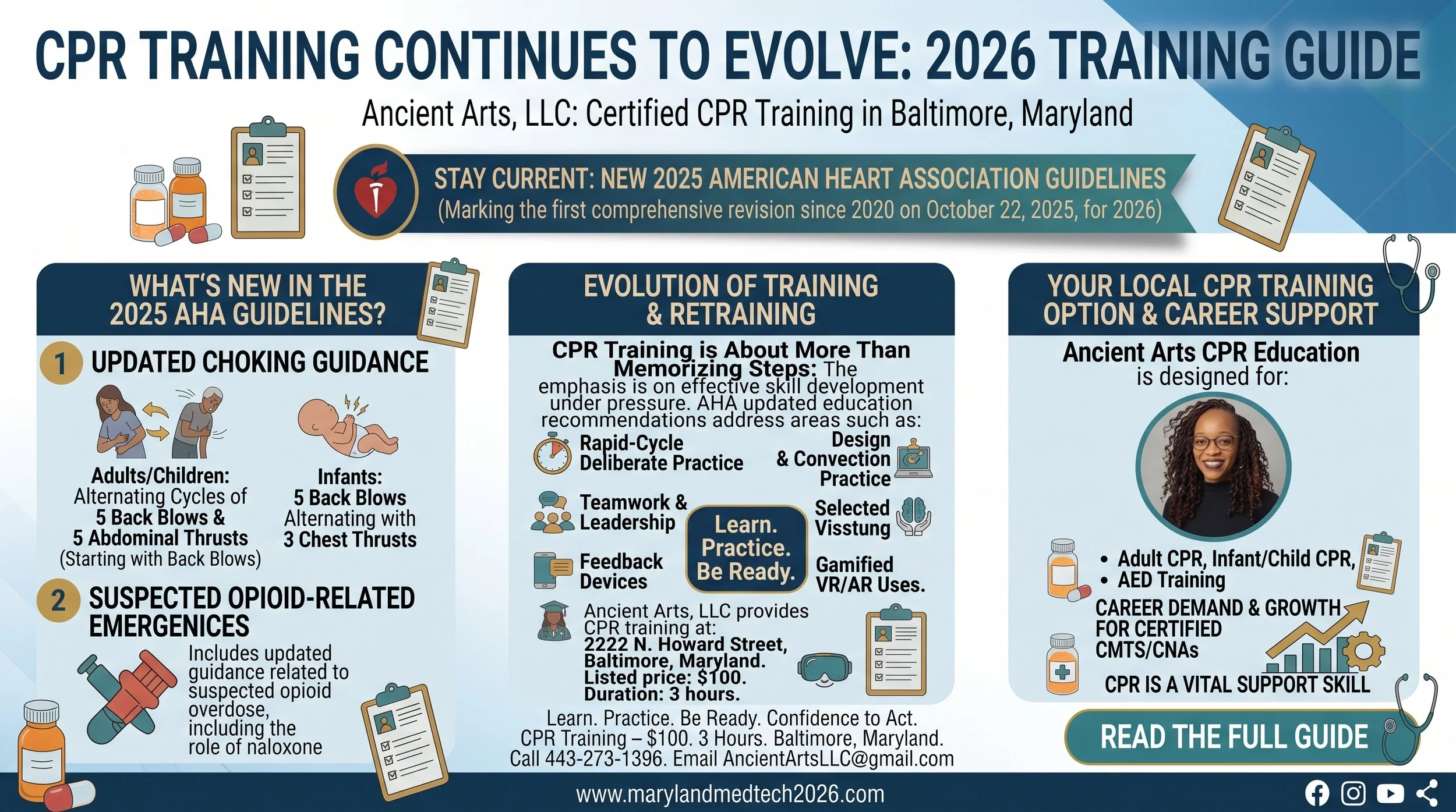
The American Heart Association released its 2025 Guidelines for Cardiopulmonary Resuscitation and Emergency Cardiovascular Care on October 22, 2025, marking the first comprehensive revision of its CPR and ECC guidelines since 2020. professional.heart.org
For people taking CPR or BLS training in 2026, that matters.
Training should reflect current evidence and current recommendations rather than relying on outdated habits or information.
What Changed in the 2025 AHA Guidelines?
The updated guidelines cover a broad range of resuscitation topics, including adult and pediatric basic life support, education and training, systems of care, special circumstances, and post-cardiac-arrest care.
CPR Training Continues to Evolve
CPR training is not something that should remain frozen in time.
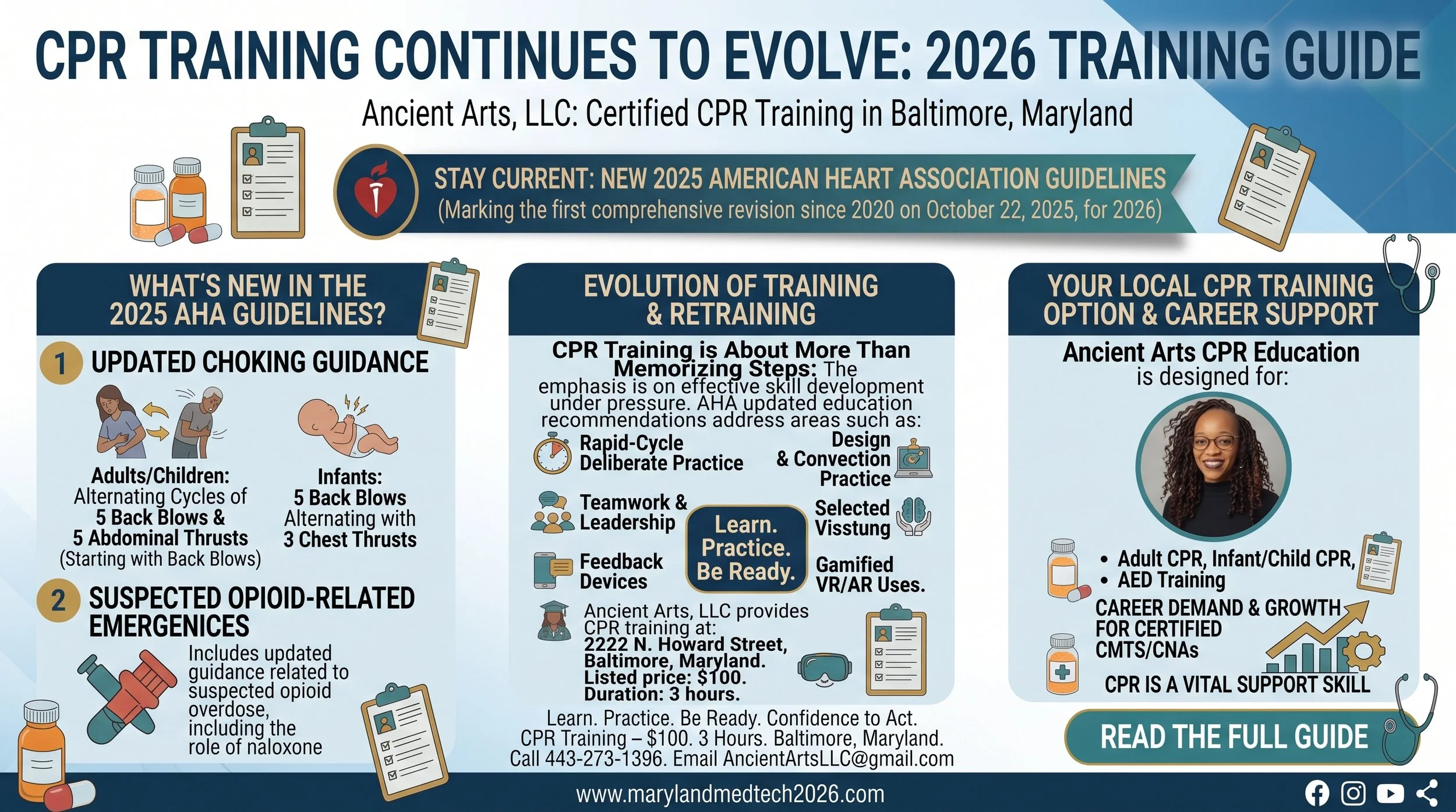
The American Heart Association released its 2025 Guidelines for Cardiopulmonary Resuscitation and Emergency Cardiovascular Care on October 22, 2025, marking the first comprehensive revision of its CPR and ECC guidelines since 2020. professional.heart.org
For people taking CPR or BLS training in 2026, that matters.
Training should reflect current evidence and current recommendations rather than relying on outdated habits or information.
What Changed in the 2025 AHA Guidelines?
The updated guidelines cover a broad range of resuscitation topics, including adult and pediatric basic life support, education and training, systems of care, special circumstances, and post-cardiac-arrest care. professional.heart.org
Several updates received particular attention.
Updated choking guidance
The AHA updated recommendations for severe foreign-body airway obstruction.
For conscious adults and children with severe choking, the updated approach uses alternating cycles of five back blows and five abdominal thrusts, beginning with back blows. For infants, the recommendation uses five back blows alternating with five chest thrusts. American Heart Association
These changes are exactly why periodic retraining matters.
Greater attention to opioid-related emergencies
The 2025 guidelines also incorporate updated guidance related to suspected opioid overdose, including the role of naloxone in appropriate emergency situations. cpr.heart.org
For communities and healthcare professionals, emergency preparedness increasingly involves understanding how different emergencies can intersect.
CPR Training Is About More Than Memorizing Steps
One of the interesting developments in the 2025 guidelines is the attention given to how CPR is taught, not simply what information is taught.
The AHA's updated education recommendations address areas such as:
rapid-cycle deliberate practice
teamwork and leadership
feedback devices
instructor training
simulation
gamified learning
selected uses of virtual and augmented reality cpr.heart.org
The emphasis is clear: effective training should help people develop skills they can actually use under pressure.
Who Should Consider CPR Training?
CPR skills are useful across many settings.
Ancient Arts provides CPR education designed for:
Healthcare professionals
Caregivers
Childcare providers
Businesses and workplaces
Community members
Individuals and families
The training currently offered by Ancient Arts includes:
Adult CPR
Infant/Child CPR
AED Training
CPR Training in Baltimore
Ancient Arts, LLC provides CPR training at:
2222 N. Howard Street
Baltimore, Maryland
The current listed price is:
$100
Course duration: 3 hours
There are currently no upcoming class dates published, but the website's calendar can be updated as new training dates are scheduled.
Why Staying Current Matters
Imagine being faced with a cardiac emergency and realizing that the last CPR class you took was based on information you can no longer remember clearly.
That is why training matters.
The purpose of CPR education is not to create a perfect test-taker. It is to help people recognize an emergency, respond appropriately, perform quality CPR, and use an AED when appropriate.
The AHA's 2025 guidelines continue to emphasize early recognition, effective resuscitation, and systems of care designed to improve outcomes after cardiac arrest. cpr.heart.org
Learn. Practice. Be Ready.
The best time to think about CPR training is before you need it.
Whether you are a healthcare professional renewing your skills, a caregiver responsible for another person's safety, a business preparing its team, or someone who simply wants to be prepared, current CPR training can give you something invaluable:
the confidence to act.
Ancient Arts, LLC provides professional CPR education in Baltimore with a focus on practical, culturally responsive instruction.
CPR Training — $100
3 Hours
Baltimore, Maryland
Call 443-273-1396
Email AncientArtsLLC@gmail.com
Contact Ancient Arts to ask about upcoming CPR training dates.
CPR training should be completed through an appropriately authorized training provider. Always follow the current course materials and guidance provided by the American Heart Association and your instructor.
Certified Medication Technician Training in Maryland: What to Know in 2026
Understanding CMT Training in Maryland
For caregivers and healthcare workers in Maryland, medication administration is more than simply knowing how to give a medication. It requires training, competency, appropriate supervision, documentation, and an understanding of the responsibilities associated with medication administration.
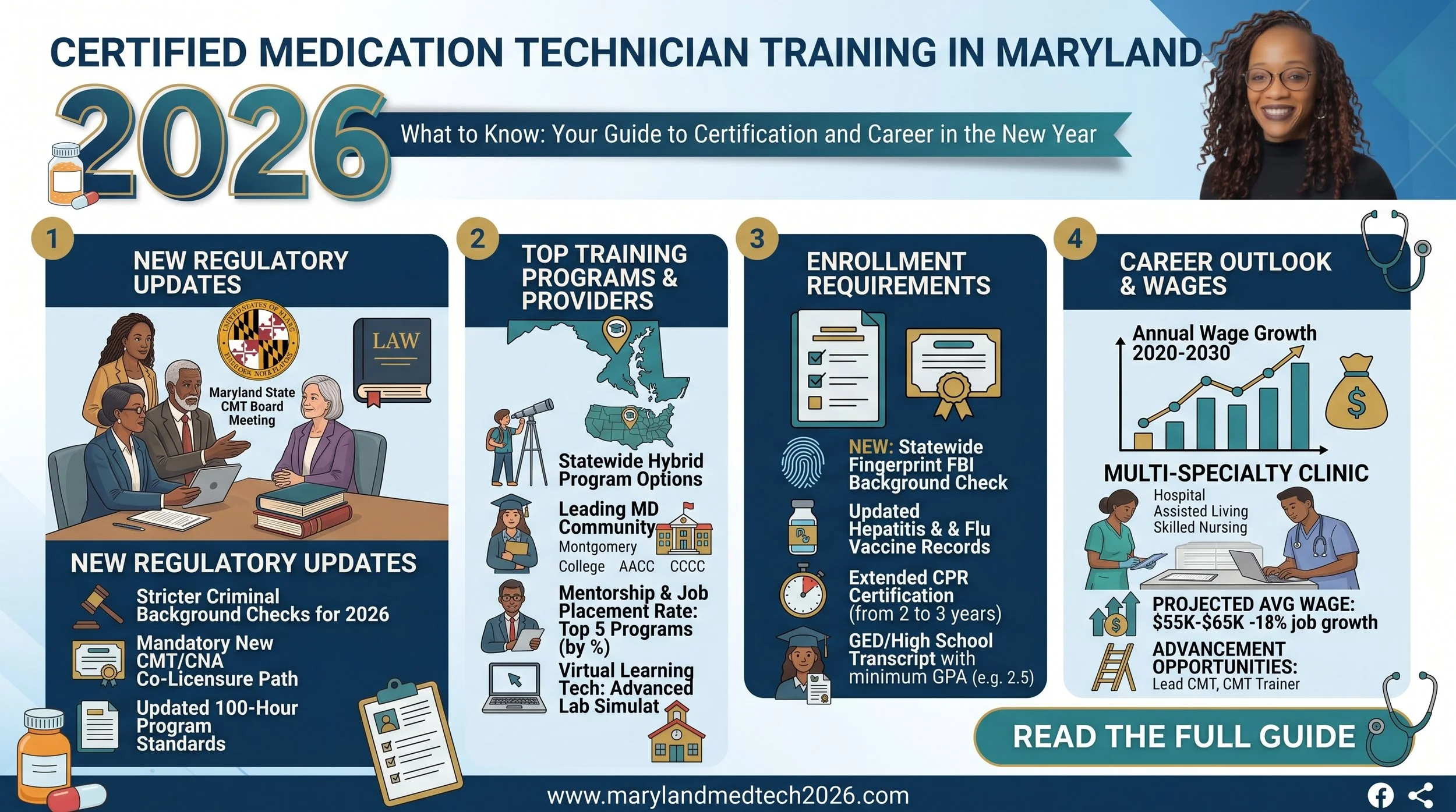
The Maryland Board of Nursing currently identifies a 20-hour Medication Technician Training Program as part of the state's requirements. The Board explains that the program contains both core medication content and content specific to the practice setting. It also includes a clinical observation component in which the student is observed administering medication in the practice setting. Maryland.gov Enterprise Agency Template
For people considering Certified Medication Technician training in Maryland in 2026, understanding these requirements before enrolling can help make the training process much clearer.
What Does a Certified Medication Technician Learn?
A CMT training program is designed to build practical knowledge and medication-administration skills.
Among the areas covered are medication safety, medication administration, documentation, infection control, and responsibilities related to the practice setting. Maryland's current training requirements distinguish between core material that applies across settings and additional content specific to the setting where the medication technician will work.
Learn what Maryland caregivers should know about CMT training, 20-hour initial training, clinical requirements, and renewal requirements in 2026.
Understanding CMT Training in Maryland
For caregivers and healthcare workers in Maryland, medication administration is more than simply knowing how to give a medication. It requires training, competency, appropriate supervision, documentation, and an understanding of the responsibilities associated with medication administration.
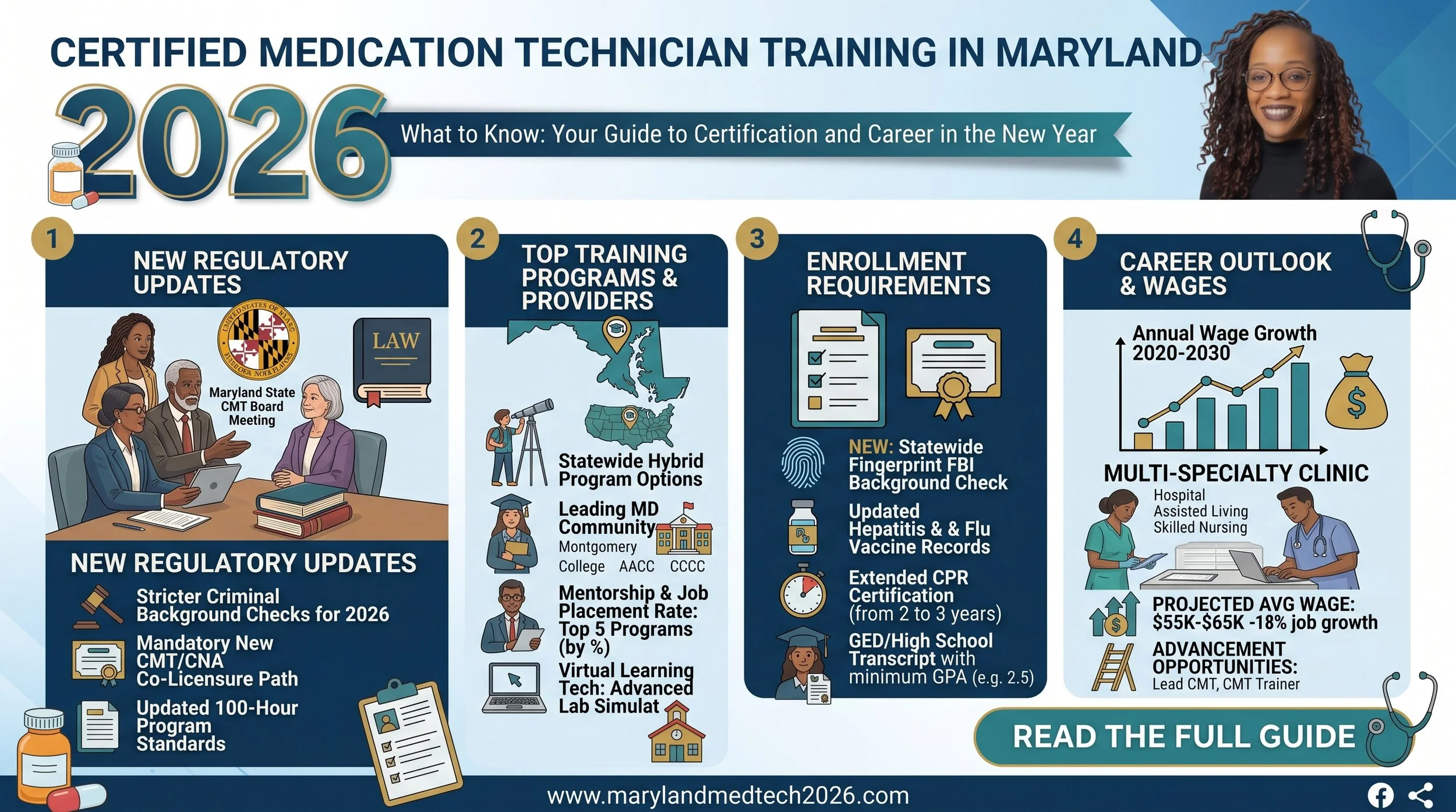
The Maryland Board of Nursing currently identifies a 20-hour Medication Technician Training Program as part of the state's requirements. The Board explains that the program contains both core medication content and content specific to the practice setting. It also includes a clinical observation component in which the student is observed administering medication in the practice setting. Maryland.gov Enterprise Agency Template
For people considering Certified Medication Technician training in Maryland in 2026, understanding these requirements before enrolling can help make the training process much clearer.
What Does a Certified Medication Technician Learn?
A CMT training program is designed to build practical knowledge and medication-administration skills.
Among the areas covered are medication safety, medication administration, documentation, infection control, and responsibilities related to the practice setting. Maryland's current training requirements distinguish between core material that applies across settings and additional content specific to the setting where the medication technician will work. Maryland.gov Enterprise Agency Template
At Ancient Arts, our training information is organized around practical learning, including:
Medication safety and the Five Rights
Oral, topical, and other applicable medication administration
Infection control and safety
Side-effect monitoring and reporting
Documentation and regulatory compliance
Hands-on skills practice
Competency evaluation
The 20-Hour Requirement Matters
One of the most important points for prospective medication technicians is that the classroom component is 20 clock hours under the Maryland Board of Nursing's current training framework. The Board also identifies a clinical observation requirement that is separate from those 20 classroom hours. Maryland.gov Enterprise Agency Template
That means prospective students should not look only at the number of classroom hours when comparing training opportunities. They should also understand what practical and clinical requirements are associated with the program.
Who Can Enter a Maryland Medication Technician Training Program?
The Maryland Board of Nursing identifies specific eligibility requirements for entry into the medication technician training program. These include being at least 18 years old, meeting basic reading and math testing requirements, and being employed in an eligible practice setting such as assisted living, school health, juvenile services, or developmental disabilities. Maryland.gov Enterprise Agency Template
Because eligibility can depend on the setting and current Board requirements, prospective students should confirm that they meet the requirements before registering.
What About CMT Renewal?
Initial training is only one part of maintaining certification.
Maryland requires medication technicians to complete a four-hour Clinical Update as part of the renewal process. The Maryland Board of Nursing states that the Clinical Update must be completed before renewal and generally within the 90-day period before the certificate expires. Maryland.gov Enterprise Agency Template
The Board also states that medication technician certification is renewed on a two-year cycle after the first renewal. Maryland.gov Enterprise Agency Template
This makes it important for CMTs to pay attention to their expiration dates rather than waiting until the last minute.
Ancient Arts CMT Training
Ancient Arts, LLC provides:
20-Hour Initial CMT Training — $300
4-Hour Renewal Class — $150
Training is offered at:
2222 N. Howard Street
Baltimore, Maryland
Registration is handled directly through Ancient Arts.
The goal is not simply to complete classroom hours. Effective training should help participants understand medication safety, perform required skills, recognize potential problems, and take their responsibilities seriously.
Before You Register
Before signing up for a medication technician course, make sure you understand:
Who is eligible?
Confirm that your employment setting and other prerequisites meet Maryland's requirements.
What does the course include?
Ask about classroom content, skills practice, competency evaluation, and any required clinical component.
How does renewal work?
Understand your Clinical Update and renewal responsibilities before your certificate expires.
Who is teaching the course?
Make sure the training provider and instructor meet the applicable Maryland Board of Nursing requirements.
Ready to Begin?
Whether you are preparing for your first medication technician training or planning a renewal, having the right information can make the process much easier.
Ancient Arts, LLC offers Maryland-focused Medication Technician training in Baltimore.
$300 — 20-Hour Initial Training
$150 — 4-Hour Renewal Training
Contact Ancient Arts to ask about registration and upcoming training opportunities.
Call: 443-273-1396
Email: AncientArtsLLC@gmail.com
Training requirements can change. Prospective students should confirm current eligibility and regulatory requirements with the Maryland Board of Nursing.